
Posted on
August 11th 2025
Tags
True or false : submarine cables carry 99 % of the world's Internet traffic?
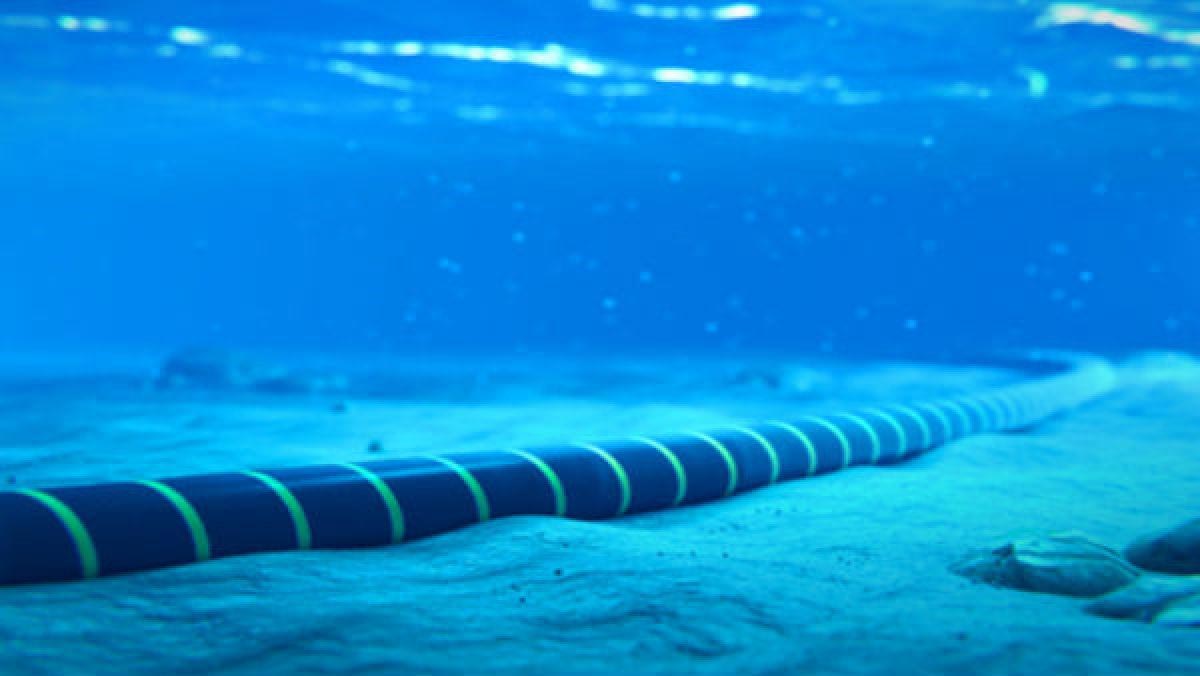
Regularly, mainstream media report a surprising statistic : submarine cables are said to carry 99 % of the world’s Internet traffic.
Submarine telecommunications cables
Since the second half of the 19th century, telecommunications cables have been laid on the seabed of seas and oceans to make long-distance communications easier and quicker. These cables were first used for the telegraph, then for the telephone and today for the Internet. According to TeleGeography, there are currently more than 600 active or planned submarine cables, for a total of over 1.48 million kilometers, enough to circle the Earth 37 times at the equator ! These cables, often owned by telecom operators or GAFAM companies, are a key part of the Internet network we use every day. But how dependent are we on them exactly ? Is it true that over 99 % of the world’s Internet traffic depends on these cables ?
True…
Watching a video hosted in the USA from Europe, sending an email to Japan, or chatting with Australia ; the data exchanged during these activities will pass through submarine cables. Indeed, intercontinental internet traffic can’t travel over land. As a result, there are 2 options : traveling by air or by sea. In other words, either using communications satellites or submarine cables. And 99 % of the time, this intercontinental traffic does indeed pass through submarine cables. A report from the US Federal Communications Commission, using data from 2013, has highlighted that communications satellites only account for 0.37 % of the total international capacity of the United-States of America. And more recently, Alan Mauldin, a research director at TeleGeography, presented a study(1) confirming those results. This study shows that, adding up the network capacities of all submarine cables and communications satellites, based on capacity projections for 2026, submarine cables represent more than 99 % of this capacity. And this is not surprinsing when you consider that cables allow for a more stable and less expensive connection, with lower latency compared to satellites. Satellites, including constellations like Starlink which we are hearing more and more about, are mostly used to cover very remote or maritime areas, or in emergency situations, in case of disasters, war or instability.
… and False !
So, are we using submarine cables 99 % of the time when we send an email, chat, stream or surf the web ? The answer is no ! There is actually a difference between the intercontinental internet traffic and the total global internet traffic. Reading this blog article from France for example, the data doesn’t travel through a submarine cable, because Koevoo’s website is hosted in France. And this is a pretty common case because the most viewed content on the web are often hosted locally or distributed using CDN (content delivery network). So what percentage of the global internet traffic really travels through submarine cables ? It’s hard to say, but a study from 2020(2) has explored this question for the global web traffic (a subset of the global Internet traffic). Researchers have selected 63 countries worldwide and have compiled a list of the 50 most popular websites for each of these countries. For each website in each country, they have located the origin of the data to determine if it was transmitted via a submarine cable. The results vary greatly from one country to another and depending on the situation of the country. Expectedly, island countries are more dependent than others on submarine cables, with an average of 42.7 % of the analysed traffic passing through submarine cable, compared to an average of 16.25 % for landlocked countries and 22.98 % on average for other countries. This is therefore a long way from the often-cited 99 % of total traffic, but reliance on submarine cables remains very high and these infrastructures are of major strategic importance. This is why these cables have received increasing attention recently, as they are key targets for espionage and sabotage in a context of geopolitical tensions(3)(4)(5)(6).
💡 Tip !
Thanks to the interactive map proposed by TeleGeography, you can explore all the submarine cables used today.

(1) Mauldin, A. (2023), presentation at SubOptic.
(2) Liu, S., Bischof, Z. S., Madan, I., Chan, P. K., & Bustamante, F. E. (2020, October). Out of sight, not out of mind: A user-view on the criticality of the submarine cable network. In Proceedings of the ACM Internet Measurement Conference (pp. 194-200).
(3) Le Monde, 11/08/2025
(4) TF1 Info, 27/08/2025
(5) Le Point, 10/09/2025
(6) Franceinfo, 06/06/2021
©Cover photo honestcable.com ; TeleGeography submarine cable map, 2025
Other posts
Every post >Contact
Let's meet !
Thank you for reading our blog. If you wish to find out more, feel free to contact us.
Koevoo needs the contact details you provide to contact you about our products and services. You can unsubscribe from these communications at any time. See our Privacy Policy to learn more about how to unsubscribe, our privacy policies and our commitment to privacy.