
Posted on
June 25th 2025
Tags
Which tool to estimate a website's environmental footprint ?

Introduction
The environmental footprint of digital technologies is well established and reducing it is a priority, which is why it is important to consider, among other things, the environmental footprint of websites. Good news : the web is full of free tools that can estimate a website’s environmental footprint based on its URL. While the existence of these tools is a very positive sign for sustainable IT, it is not always easy to navigate through all of these options, which sometimes give very different results ! So, whether you want to develop the most responsible website possible or you’re simply curious, which tool should you use ? Here is an overview of your options !
Overall footprint tools
Among the available options, several tools allow an estimation of the environmental footprint of a website that include the impacts of the 3 Tiers (user device, network and data center).
Ecoindex
Ecoindex is an online tool created by the Green IT association. It is based on an LCA (life cycle analysis) that estimated that the average impact of a web page was 2 g CO2 eq. and 3 cl of blue water.
Ecoindex computes a score between 0 and 100 based on 3 indicators :
• the page weight (in MB)
• the number of DOM (Document Object Model) elements
• the number of HTTP requests
Based on this score, the tool provides an estimate for the amount of greenhouse gases (GHG) emitted and the amount of water consumed for each visit to the site, assuming that a website with a score of 50/100 has an average footprint (2 g CO2 eq. and 3 cl of blue water).
The Sustainable Web Design Model
The Sustainable Web Design Model (SWDM) is an open source model estimating the GHG emissions of digital services, created as part of a collaboration between Wholegrain Digital, Mightybytes, Footsprint, EcoPing, and Green Web Foundation. It only estimates the GHG emissions caused by electricity consumption, taking into account the user device, the network and the data center, both during the use phase and during production. To that end, the model uses the amount of data (in GB) transmitted during a visit to the website to infer the amount of electricity used. This amount of electricity is then converted into GHG emissions by multiplying it by the carbon intensity factor of the electricity mix.
The Website Carbon calculator, Website Emissions, Kastor, Ecograder and Cabin tools are all based on this model.
Beacon : the OneByte model
Beacon is an online service created by Aline based on the OneByte model. This model estimates GHG emissions by taking into account only the electricity consumption of the 3 tiers (data center, network and user device). As for the SWDM, the OneByte model is based on the amount of data (in GB) transmitted during a visit to the website. Based on the URL, Beacon provides 2 estimates of the amount of GHG emitted during each visit : 1 estimate for the first visit to the page, and another one for subsequent visits, taking into account that a certain amount of data has been cached and doesn’t need to be transmitted over the network again.
The “specialised” tools
In addition to the overall footprint tools, several more specialised tools are available. They aim to estimate more accurately a subset of the website’s footprint or to evaluate a specific aspect, such as its hosting.
Green Web Check
The first tool that can be mentioned in this category is Green Web Check.
This tool, created by the Green Web Foundation, identifies whether the website is hosted in a data center powered by “green” energy.
In order to do this, the IP address associated with the website is compared to the Green Web Dataset, a list of verified hosting providers that have provided the Green Web Foundation with evidence of their efforts to reduce the environmental footprint of the electricity they use.
However, this tool doesn’t differentiate between direct renewable energy supply and the use of carbon credits : both allow to be identified as a “green” hosting service.
Yet, this is questionable as the two are not equivalent, as we will discuss in a future article.
Several models computing the overall footprint of websites actually use the results of Green Web Check to feed their own model.
Greenoco
Greenoco focuses on the impacts caused by the electricity consumption of the data center. To that end, the tool estimates the electricity consumption generated by visits to the site based on the number of requests and the bandwidth used. Using the PUE (Power Usage Effectiveness), the tool takes into account the electricity consumption of all equipement in the data center, not just that of the servers. Finally, the electricity consumption values are multiplied by the carbon intensity of the electricity mix of the hosting country.
Summary
Each tool presented here has its own advantages and limits, but it should be noted that all of the tools mentioned use a relatively small number of variables to compute their estimates. In particular, for the impacts at the data center level, these tools don’t take into account the amount of server resources (RAM and CPU) actually used by the site. Indeed, even though this data is crucial to estimate a website’s impact, it is impossible to access for sites that we don’t manage ourselves. However, it is possible to know the underlying technology of a website, and it could be interesting to include this information into environmental footprint tools as it has a direct impact on a website’s server-side resources consumption.
| Tool | GHG | Page weight | "Green" hosting | Actionable recommendations | Tiers |
| Beacon | Yes | Yes | Yes | Yes | 3 |
| Cabin | Yes | Yes | Yes | No | 3 |
| Ecoindex | Yes | Yes | No | No | 3 |
| Ecograder | Yes | Yes | Yes | Yes | 3 |
| Greenoco | Yes | Yes | No | Yes | Data Center |
| Green Web Check | No | No | Yes | No | Data Center |
| Kastor | Yes | Yes | Yes | Yes | 3 |
| Website Carbon Calculator | Yes | No | Yes | No | 3 |
| Website Emissions | Yes | No | Yes | No | 3 |
Summary table showing, for each tool : whether it provides an estimate of greenhouse gas emissions, displays the weight of the tested page, accounts for data center power supplied from green energy and/or the use of carbon credits, suggests actions to reduce the website's footprint and which tiers are taken into account.
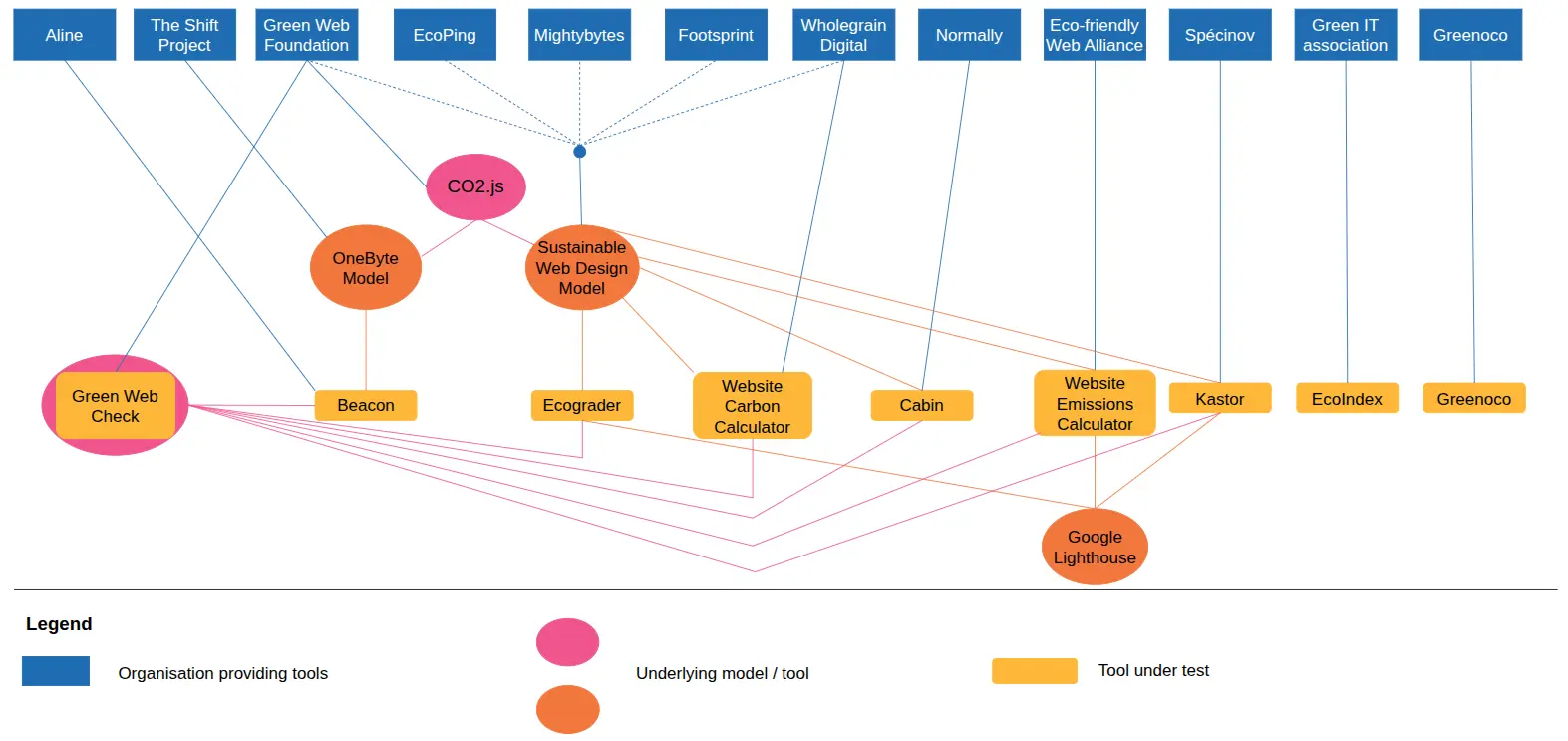
Overview of the tested tools, their providers and the underlying models.
💡 Tip !
Numerous tools are available, each with their strengths and limitations, and tool selection depends on the context and the intended goal.
Here are a few elements to consider when making your choice :
To get the most comprehensive picture possible : use an overall footprint tool, such as Ecoindex for example, which is the tool with the broadest scope.
On the other hand, tools based on the SWDM model have the advantage of relying on a widely used open source methodology.
Finally, from an eco-design perspective, it is worth selecting tools that provide actionable recommendations, and possibly a tool focusing on the data center, which is the tier where the most direct impact can be achieved.
© Cover picture including a photo from wayhomestudio, Freepik.
Other posts
Every post >Contact
Let's meet !
Thank you for reading our blog. If you wish to find out more, feel free to contact us.
Koevoo needs the contact details you provide to contact you about our products and services. You can unsubscribe from these communications at any time. See our Privacy Policy to learn more about how to unsubscribe, our privacy policies and our commitment to privacy.