
Posted on
June 2nd 2025
Tags
Estimating and reducing the environmental footprint of a website: where to focus your efforts?

The environmental footprint of digital technologies includes the impacts of all the equipment, but also the impacts of the services, such as the websites we use daily. Then, how can we estimate the environmental footprint of a website, and effectively reduce it through an ecodesign approach ?
An environmental footprint shared across 3 Tiers
To better understand the environmental footprint of a website, the impacts are often broken down into 3 Tiers :
- The data center : where the server hosting the site is installed.
- The network : used to transfer data between the server and the user.
- The user device : the device used by the end user to access the website.
Although each tier contributes to the overall footprint of the website, the impacts are not evenly distributed among the tiers. Even more importantly, when seeking to reduce a website’s footprint, our ability to take action varies depending on the tier considered.
User device : impacts largely beyond the website’s control
One way to estimate the environmental impact of a website is to conduct an LCA : a Life Cycle Analysis(1)(2).
In this analysis the electricity consumed by the laptop or the smartphone of the end-user while consulting the website is considered.
But this is not the only impact attributed to the user device in an LCA for a website.
In fact, the production of a user-device causes various impacts (greenhouse gases (GHG) emissions, pollutions, extraction of non-renewable ressources…) and the LCA attributes a fraction of these impacts to each use of the device, including visiting a website.
The impacts generated by the production of the device are the most significant.
Indeed, for laptops and smartphones, the electricity consumed during the use phase only accounts for a small portion of the impacts (as illustrated in this article).
While this environmental impact modelling is useful, it has limitations and is not the only way to account for environmental impacts.
Actually, whether the website visited with the user device is ecodesigned or not will have very little (if any) impact on how often the end-user device is replaced(3).
That’s why, realistically, website ecodesign is unlikely to significantly reduce the major impacts associated with device manufacturing.
Network : an indirect lever
As for network infrastructures, the electricity consumed by the devices must also be considered, as well as the impacts associated with their production.
These impacts are typically modeled as being proportional to the amount of data passing through the network.
However, the reality is more nuanced, as network devices are constantly powered and consume electricity continuously.
There is a lack of precise data from a large sample of devices to properly assess this question.
Studies conducted on certain equipment show that power consumption varies very little between low and high traffic levels.
Power consumption is more closely related to the amount of resources deployed than to the instantaneous amount of traffic routed.
Which is why transferring twice as much data doesn’t consume twice as much electricity for network equipment(4).
As for the manufacturing, the number of network devices used depends on the overall traffic, and even more on traffic peaks, which determines the “pipe sizes” in the infrastructure.
Yet nowadays, traffic peaks occur in the evening due to the consumption of video streaming(5).
Only by reducing overall video traffic during these “peak hours” can this footprint be limited.
Moreover, the traffic associated with displaying a website page (excluding video) is, at worst, equivalent to a few seconds of video (and often less than 1 sec).
Therefore, ecodesigning a website by reducing the quantity of data passing through the network would have very little impact on the environmental footprint of network infrastructure.
Data center : the main lever
Finally, the environmental footprint of a website also includes the impacts of the data center where it is hosted : the electricity consumed by the servers and other, constantly powered, essential equipment, including for cooling ; as well as the production of all this equipement.
Ecodesigning a website allows for a direct reduction of these impacts.
For the power consumption during the use phase, one of the most impactful action to take is to consider the carbon intensity of the electricity mix when choosing in which country to host a website, as explained in this article.
Choosing a more sustainable data center, with a low PUE (Power Usage Effectiveness)(6), can further reduce this impact.
To reduce the impacts associated with the production, the most important thing is to limit the resources (CPU and RAM) used by the website on the server.
Indeed, servers have a limited capacity to manage several sites simultaneouslty.
The less resources a website requires, the greater the number of websites that can be hosted on the same server.
It is then possible to limit the production of these devices and the resulting environmental impacts.
Choosing the right technologies to develop a website is critical when it comes to addressing these concerns.
For example, we measured that there could be a factor of 10 to 20 in the amount of server resources consumed between 2 technologies for the same website (details in this article).
In an ecodesign approach, it is essentail to identify where to focus your efforts to minimise the environmental impacts.
In the case of a website, actions aiming to reduce the impacts at the level of the data center are the most likely to have significant direct impacts.
This doesn’t mean that the 2 other tiers should be overlooked, as every optimisation matters, but it is important de prioritise our actions to take the most concrete steps towards a more sustainable digital world.
💡 Tip !
Make the right choices to reduce the environmental footprint of your website hosting :
- Choose a country with low-carbon electricity
- Choose a data center with a low PUE
- Choose technologies that minimise resource usage
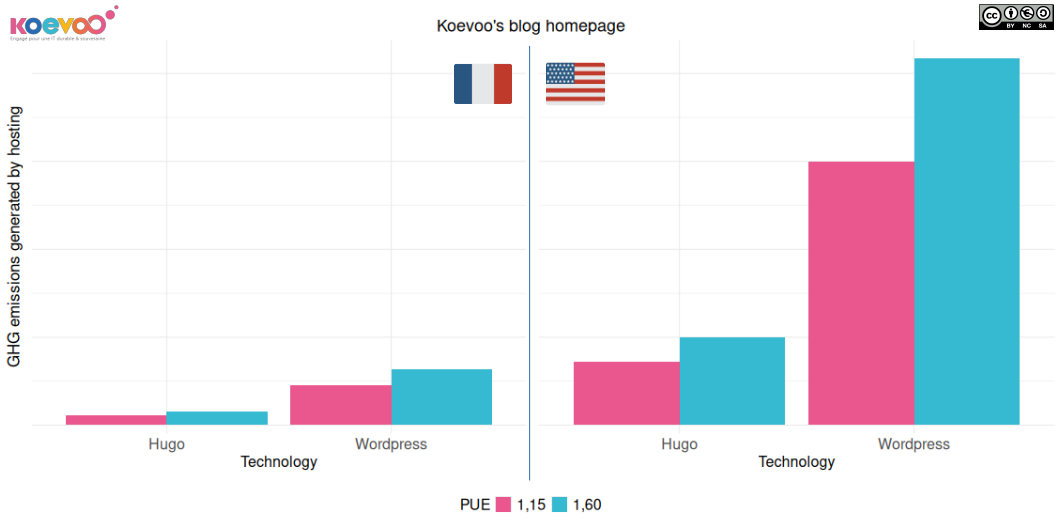
To illustrate the impact of these choices, the chart below shows how the different elements affect the GHG emissions from hosting Koevoo’s blog homepage.
(1) International Organization for Standardization (2006). ISO 14040 : Environmental management — Life cycle assessment — Principles and framework.
(2) International Organization for Standardization (2006). ISO 14044 : Environmental management — Life cycle assessment — Requirements and guidelines.
(3) Arcep, Arcom, CGE, ANCT, Baromètre du numérique, édition 2025. p.21
(4) Mytton, D., Lundén, D., & Malmodin, J. (2024). Network energy use not directly proportional to data volume: The power model approach for more reliable network energy consumption calculations. Journal of Industrial Ecology, 28(4), 966-980.
(5) The Shift Project, 2019. Climat : l’insoutenable usage de la vidéo en ligne. p.11
(6) PUE is a metric for the energy efficiency of a data center
(7) Joint Research Center (2023)
© Cover picture rawpixel.com, Freepik ; Flag icons from Smashicons, Flaticon.
Explore the data with Koevoo :
Network : an indirect lever
“The traffic associated with displaying a website page (excluding video) is, at worst, equivalent to a few seconds of video (and often less than 1 sec).”
-> According to the 2024 web almanac from Httparchive, the median page weight is about 2,7 Mo. Given that a low-resolution video requires at least 1Mb/s… at worst, an average website corresponds to 22 seconds of video.
Chart from the Tip ! section
This chart is based on an underlying piece of data, generated with the Greenoco tool : going from Wordpress to Hugo (without any other changes) leads to a 70 % reduction in GHG emissions of koevoo’s blog homepage for the data center tier.
We then compare hosting in France and in the USA, based on carbon intensity data from the impacts database of ADEME. Finally, we compare a PUE of 1,6 (which is the mean value of PUE for data centers in the EU(7)) to a low PUE of 1,15.
Other posts
Every post >Contact
Let's meet !
Thank you for reading our blog. If you wish to find out more, feel free to contact us.
Koevoo needs the contact details you provide to contact you about our products and services. You can unsubscribe from these communications at any time. See our Privacy Policy to learn more about how to unsubscribe, our privacy policies and our commitment to privacy.